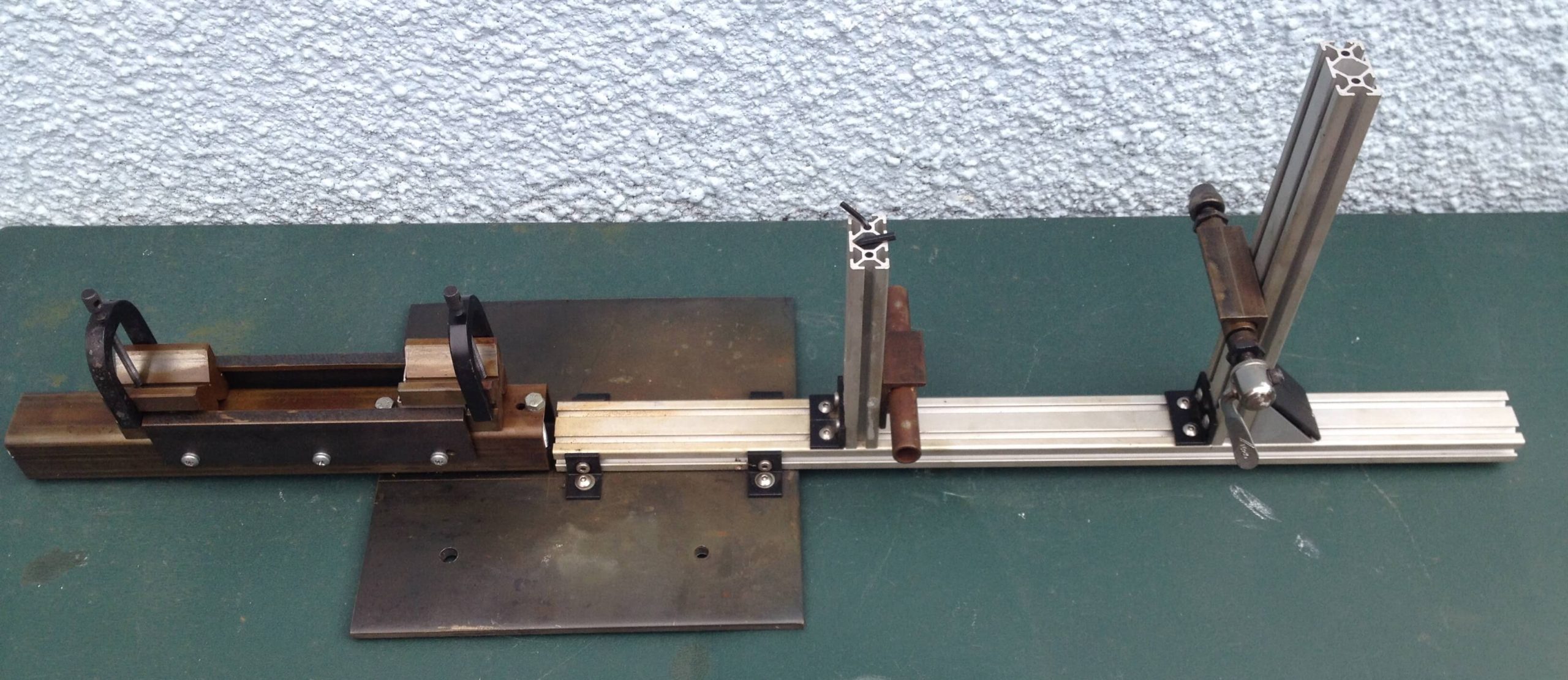
I have managed to make a jig for building forks. I have found it very effective and it was not too difficult to make. I used a 8mm thick piece of steel plate as the base plate topped with a 40mm square section and two v blocks. The square section was attached to the base plate by drilling through, tapping the baseplate and inserting bolts This makes for a heavy and solid base and is heat absorptive. I then extended the base with aluminium profile fixed to the baseplate with the matching fittings and screws and added uprights to attach an axle for the dropouts and a mid fork blade support.
The dropout axle was an old 9mm front quick release axle pushed through a bit of steel tube which had been brazed onto a bit of angle iron. The support was made in a similar way. The aluminium profile was cut to the correct lengths by the supplier. V blocks were the only bits that were difficult to attach as the metal is too hard to drill. I attached them to the square section with two pieces of the same angle iron used above. This had one edge cut back so it was just deep enough to grip the side slots on the v blocks the drilled tapped and screwed into the sides of the square section. The trick to getting it accurate is to build it around a set of accurate forks so you know it is true and build in enough adjustment for different rakes and lengths of fork. I am sure there are many other ways of achieving the same result. I have since used it to build 12in, 20in, 26in and 700c forks. Set up before building does require careful measurement and the use of a spirit level or digital angle finder to make sure everything is clamped in the correct planes before brazing.